


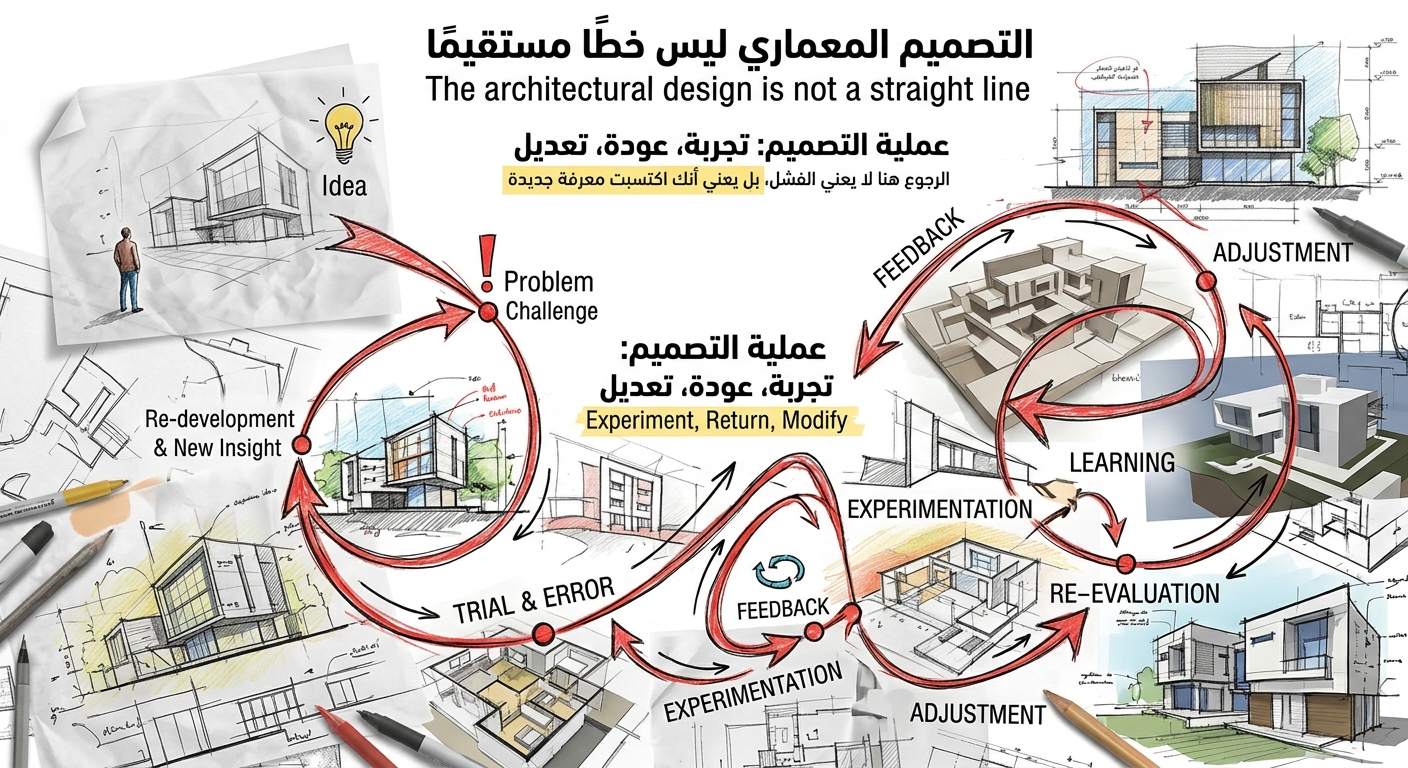
Architectural design is not a straight line. Like a Formula 1 lap, each sketch is a chance to test, learn, refine, and improve—turning each iteration into a smarter, stronger design than the last one.
Imagine you are sitting in a Formula 1 car.
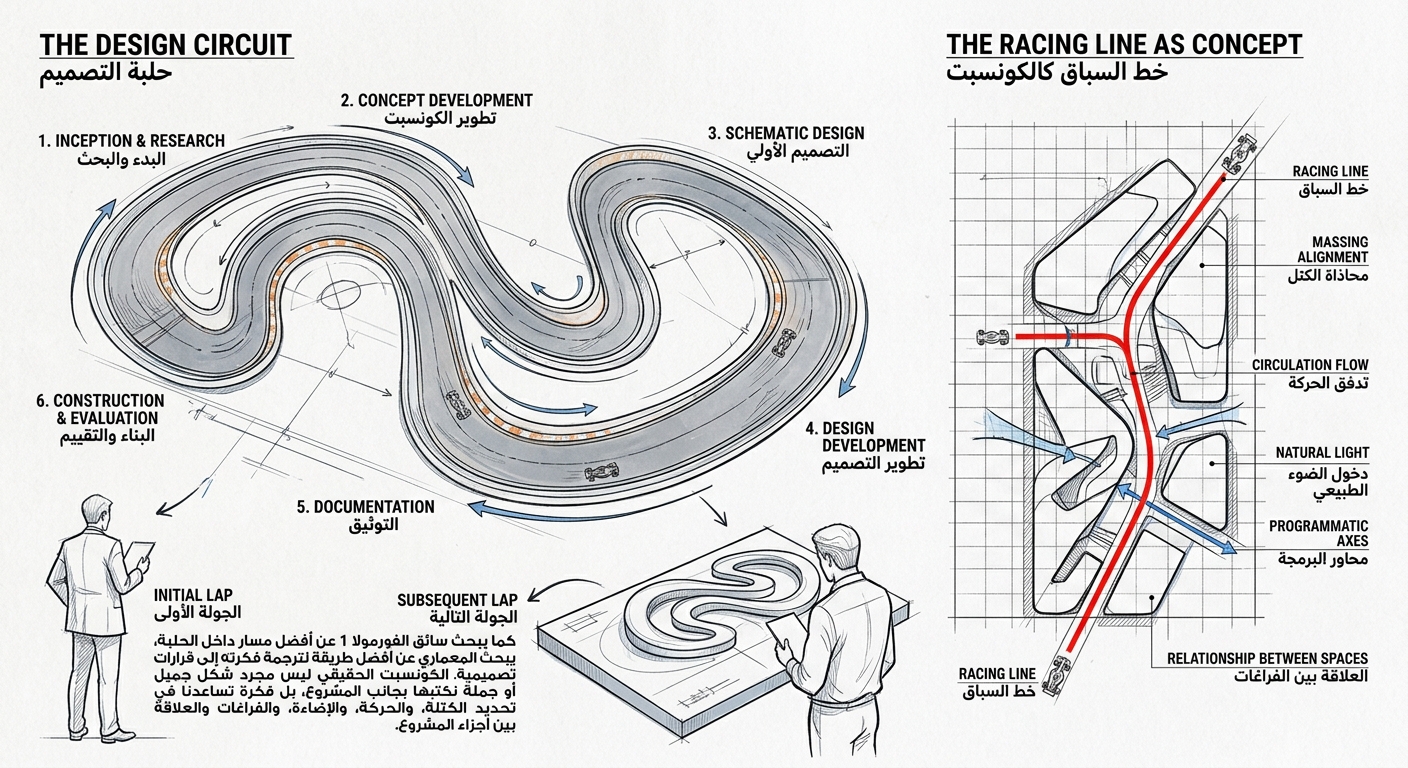
You start the lap with a clear goal: complete the circuit as quickly and efficiently as possible. You accelerate, brake, turn, adjust your racing line, and eventually cross the finish line.
But here is the interesting part: the finish line is not really the end.
The next lap begins immediately.
And the driver does not simply repeat the previous lap. They ask:
Where did I lose time?
Was my braking point too early?
Could I take this corner differently?
Can I improve my line by a few centimeters?
The next lap starts from almost the same place—but the driver starts with more knowledge than before.
This is surprisingly close to how architectural design actually works.
When architecture students begin a project, they often imagine the design process as something like this:
Site Analysis → Concept → Sketch → Plan → 3D Model → Final Design
It looks neat. It looks organized.
But real design rarely behaves this way.
Architectural design is much more like a continuous loop of exploration, testing, criticism, and refinement. Research on conceptual building design has shown that designers do not necessarily follow a single linear route; instead, they move between activities, revisit decisions, and iterate throughout the conceptual phase.
This is why your first concept does not need to be perfect.
Actually, it is not supposed to be perfect.
The first concept is simply your first lap.
A mathematical calculation usually follows a predictable sequence:
Input → Calculation → Result
Design is different.
You may begin with a site analysis and develop a concept. Then you sketch it and discover that the circulation does not work. You modify the form. The modification creates a new problem with daylight. You return to the concept. You change the orientation. Suddenly, the relationship between the spaces becomes better.
You have gone backward.
But you have not failed.
You have learned something.
This is one of the most important things architecture students need to understand:
Going back in the design process does not mean going backward in your thinking.
Sometimes, returning to an earlier idea is exactly what allows the project to move forward.
This is where the architectural sketch becomes extremely important.
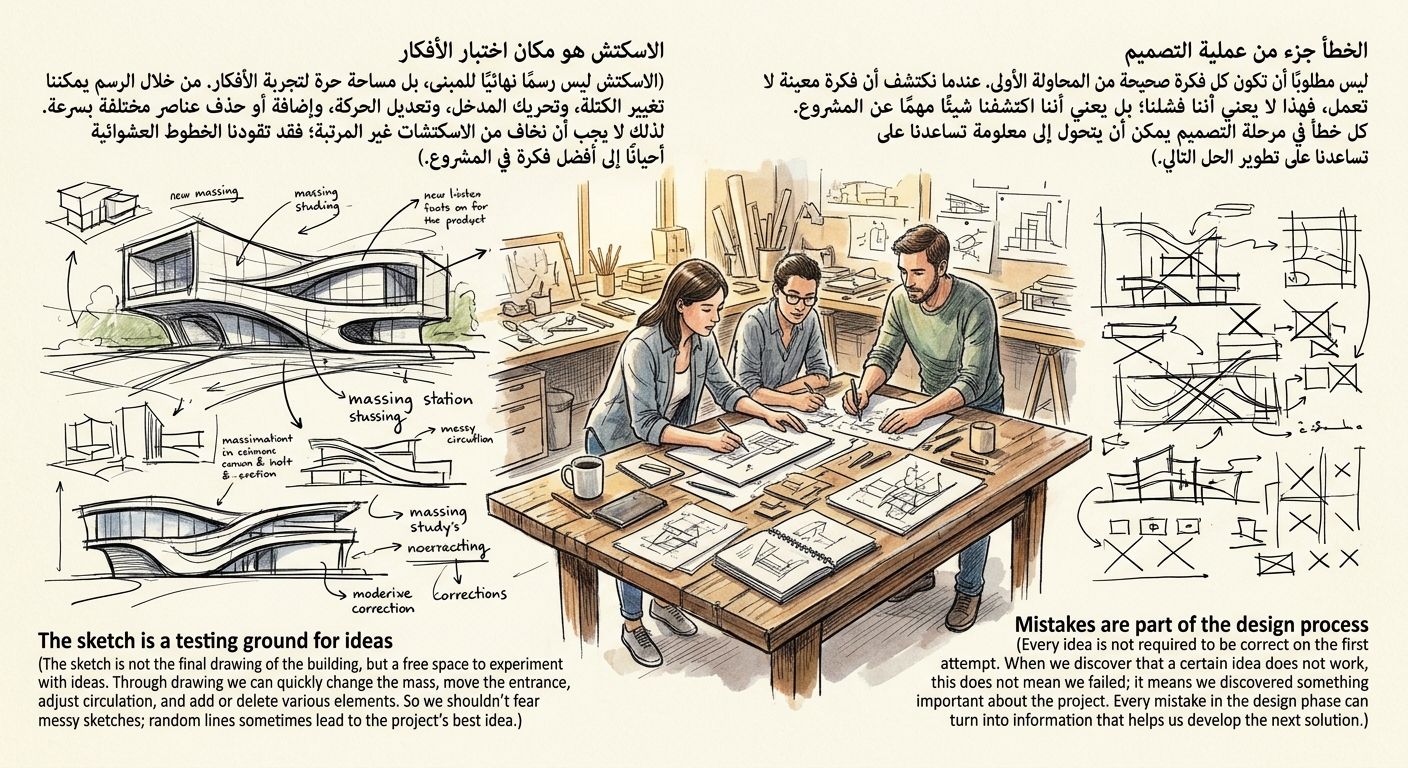
A sketch is not simply a small drawing of what your final building will look like.
It is a place where you test ideas.
You draw a line.
Then another.
You rotate the mass.
You remove something.
You add a courtyard.
You change the entrance.
You draw over the previous sketch.
And suddenly, a completely different possibility appears.
Research into architectural sketching has described sketches as fundamental artifacts of the design process, while other studies have found that sketching supports the interpretation, reinterpretation, and transformation of design ideas.
So don't be afraid of the ugly sketch.
The messy sketch.
The sketch that looks like nothing.
Sometimes, the most important architectural idea is hidden inside a drawing that would never make it onto your final presentation board.
In Formula 1, the driver is not simply trying to follow the road.
They are searching for the best racing line.
The line that allows the car to enter the corner correctly, maintain speed, exit efficiently, and prepare for the next corner.
Your architectural concept works in a similar way.
A concept is not just:
"My building is inspired by a leaf."
Or:
"My form represents movement."
The real question is:
How does that idea help you make decisions?
If your concept is movement, does it influence the circulation?
If it is light, does it influence the orientation, openings, courtyards, and spatial sequence?
If it is connection, does it influence how people move between spaces?
A strong concept becomes useful when it can generate and test architectural decisions.
This is why architectural design education places importance on moving from an initial idea toward visible, testable forms through sketches, rough drafts, evaluation, and refinement.
Now imagine an architecture student working on a cultural center.
The student sketches a simple rectangular mass.
It is not impressive.
But it establishes the basic organization.
They look at the sketch again:
"Why is the entrance here?"
"Why is the public space so far from the main circulation?"
"What happens to the building in the afternoon sun?"
The student changes the mass.
A courtyard is introduced.
The circulation improves.
But now some spaces become too dark.
Another change is required.
The student studies the openings, orientation, massing, and circulation again.
The building begins to make more sense.
The final form may look completely different from the first sketch.
But that first sketch was not wasted.
It was Lap 01.
Without it, there would have been no Lap 05.
This is a small habit that can completely change the way you design:
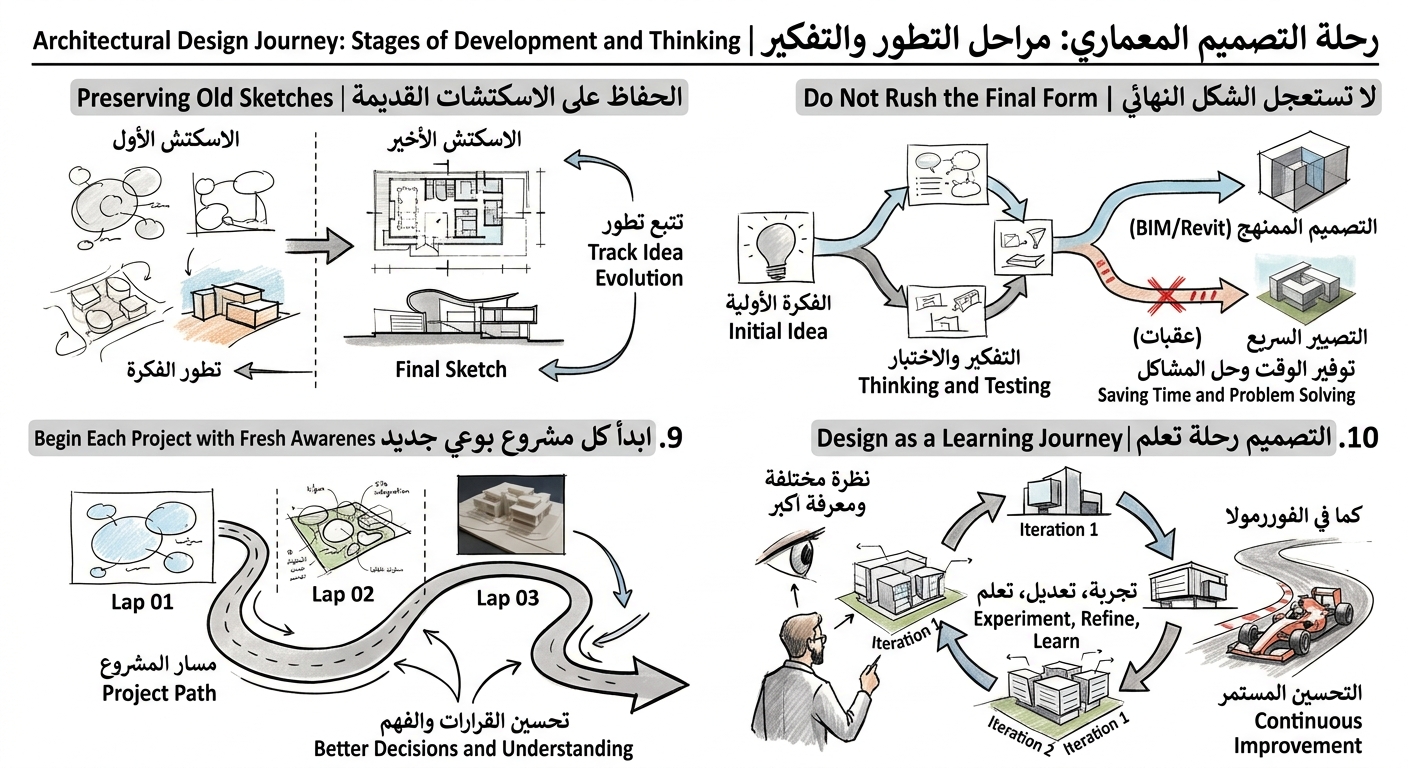
Keep your iterations.
Don't throw away every unsuccessful sketch.
Put them beside each other.
Look at:
Sketch 01 → Sketch 02 → Sketch 03 → Sketch 04 → Sketch 05
You will start to see something fascinating.
Your design is not suddenly appearing.
It is evolving.
This is also why researchers studying the conceptual phase of building design have focused on mapping iterations and decision-making rather than treating design as a simple sequence of fixed steps.
Your sketches become a visual record of your thinking.
They show not only what you designed, but how you learned to design it.
There is another important lesson from Formula 1.
A driver does not try to make the lap shorter by removing corners.
They try to make the lap better.
The same applies to architecture.
Don't rush through the concept phase just because you want to reach Revit, rendering, or the final presentation.
A few extra iterations at the beginning can save you hours—or even days—of fixing problems later.
The goal is not:
"How quickly can I finish my concept?"
The better question is:
"How much better can I make my concept before I move forward?"
So, the next time you start an architectural project, try this:
Take your first concept and call it Lap 01.
Then sketch it.
Test it.
Question it.
Break it.
Rebuild it.
And start Lap 02.
Don't ask yourself:
"Why did I have to go back?"
Ask:
"What did I learn during the last lap?"
Then use that knowledge to improve the next one.
Because architectural design is not a straight road from idea → building.
It is a continuous process of thinking → drawing → testing → failing → learning → redefining → drawing again.
Just like a Formula 1 driver, you may cross the same point many times.
But each time you return, you should be a better driver—and your design should be better architecture.
Don't try to draw the perfect building on your first lap.
Try to make every lap better than the one before it.

Link copied
Rate this post
Please log in to rate and comment. Login
Please log in to rate and comment. Login



No courses found.
0 Comments
No comments yet.